
How the CHC helped one alum steer toward a STEM career
Hometown: Tigard, OR
CHC Class of: 2010
Today’s job: Scientific Solutions Lead at Phylo Bio in the San Francisco Bay Area
Major: Human physiology
Minor: Chemistry
What’s in the fridge: A couple of HelloFresh meals (this week’s menu: Pesto Chicken & Gnocchi and Buffalo Halloumi sandwiches)
Guilty pleasure: Kraft Singles. It may be an artificial, plastic, non-cheese product… but it’s a bonafide S-tier option for grilled cheese sandwiches
Reading/watching/listening to: Reading Piranesi by Susanna Clarke; watching woodworking videos on YouTube; and listening to Baby Shark on repeat (Pinkfong owes my toddler revenue share at this point.)
First job after graduation: More school…then more school…then
postdoctoral fellowship…and then I finally started my career in the biotech software space as a scientific consultant at Benchling.
What you’re doing now: Raising my three kids, accelerating scientific progress through better software, and trying not to overspend on my home espresso setup.
Best memory of the CHC: Eating late-night calzones from The Dough Co. while my friends and I debated Plato’s cave and whether we’re all just prisoners mistaking shadows for reality.
Milind Nigam has traveled across the world, mostly seeking answers to some broad questions. But he was also seeking answers to what he wanted to do for a career.
The 2010 CHC graduate always had a nose for biology, chemistry and other STEM subjects. As a kid, he thought about going into medicine or becoming an engineer. He even considered becoming a lawyer.
But as he dabbled in the sciences in higher education, he realized there was more to finding a career than setting something in stone early on and only feeling like you succeed if you reach that goal.
“I think an important thing that I learned over all the years of school and getting my education was that you have to be ready to pivot if something comes up,” Nigam recalls. “The CHC was good at showing me that you can go in with one set of expectations but that you should always be ready to change course if market forces indicate shifting winds or if your interests simply evolve.”
He graduated with a degree in human physiology and a minor in chemistry. Then he received a master’s in science in Biomedicine from the Karolinska Institute in Sweden and a PhD. in Alzheimer’s Disease from the National Institutes of Health. He then returned to Sweden to complete a postdoctoral fellowship in cancer biology.
He settled in the San Francisco Bay area (he has a wife and three children) and worked for a variety of companies specializing in AI and machine learning for biomedical research to aid scientists with their discoveries.
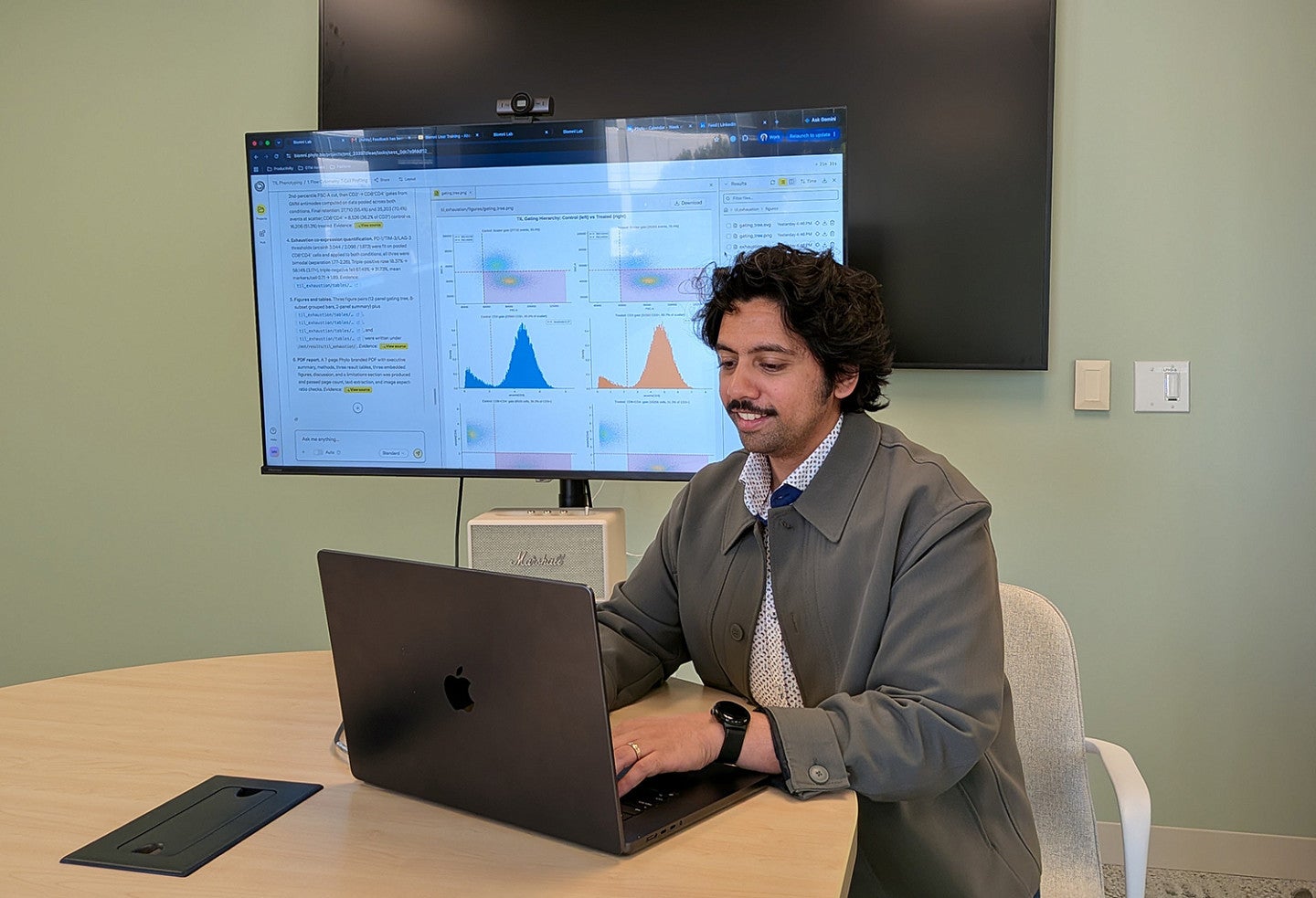
Today, he works as a scientific solutions lead for Phylo Bio, a startup in the San Francisco Bay area. It’s an applied research lab dedicated to studying agentic intelligence to accelerate discoveries for biomedical scientists.
“AI is shaking the world up and it’s in the news all the time now,” Nigam says. “Amidst all the AI noise, slop and fear, there are genuinely meaningful applications that will have positive impact on society.
“Health and medicine is one arena where the future, indeed, looks bright thanks to innovations in AI. My personal driving force is to be able to look back at the end of my career and be able to say that I played a part in improving people’s lives.”
We spoke to Nigam over the summer about his work, his family and how the CHC had an impact on his life after his undergraduate years.
This interview was edited for content and brevity.
“I’d encourage students to adopt the mentality that they aren’t working on writing up a thesis paper, but rather that they’re studying something profound to them. It’s a subtle mental shift, but having that mindset can make a daunting task feel more like an exploration of something you’re genuinely curious about. I really do believe that if you focus on a question that sincerely fascinates you, you’re unlikely to procrastinate or feel overwhelmed by it.”
You’re working primarily in a field where AI and machine learning are your primary focuses. Tell us, so the average person can understand, what it is that you do.
I sit at the intersection of AI and biology, where our goal is to help scientists make discoveries faster and do more of the science that drew them to the field in the first place. Currently, I’m working on AI agents for biomedical research. Think of them as tireless research partners that can search the literature, run complex analyses, and interpret data across biology.
Here’s the problem we’re solving. A biologist doesn’t spend most of their day thinking about disease or how cells work. They spend it wrangling a dozen disconnected tools, bouncing between databases, spreadsheets, and analysis software just to answer a single question. Where large language models (like ChatGPT and Claude) were trained to reason and act across text, we’ve built agents that reason and act across the sprawling, fragmented world of biological tools and data. A scientist describes what they want to investigate in plain language, and the agent figures out how to carry it out, connecting the tools and databases that were never designed to work together. This work – that includes next-generation tools that leverage AI and machine learning to do sophisticated things like design novel molecules – used to take weeks. Now it can happen in hours.
If you look back to your high school and college days, did you think then that this is what you’d be doing now?
Most definitely not. Back then I basically thought becoming a doctor, lawyer, or engineer were the only careers out there. I had no idea what a scientific consultant at a software company did, let alone how to become one. That, in fact, is one of my biggest takeaways from my career so far: keeping an open eye, staying adaptable, and spotting trends early is so valuable. The last one comes with experience, but if you have the outlook that pivoting is a good thing and not a failure, you’re more likely to end up somewhere successful.
What was life like for you when you were at the Clark Honors College? Were you a good student?
Life during my time at the CHC was wonderful. Smartphones weren’t really a thing, so we were fully immersed in the experience with our classmates…both in the classroom and out. I know that’s harder these days, but I’d really encourage students to make the deliberate effort to touch grass as often as you can and soak up the brilliance around you - from professors and classmates alike.
Was I a good student? Probably depends on the day. Some mornings, peeling myself out of bed to make it to class was its own achievement. But in general – yes, I definitely tried. I was pre-med for most of my time in the CHC, so I was pretty focused on maintaining my GPA. Being in the CHC made that challenging. I’m a STEM guy, so reading literature, writing essays, and analyzing historical events certainly wasn’t my strong suit. But I’m so happy I put myself through it - it made me grow into a more adaptable and curious person. Even today, I find myself routinely drawing on my liberal arts education in conversations or to enrich my work in various ways. Certainly, the topics I studied while in the CHC shaped me.
What was your thesis? And how did it help you after graduation?
For my thesis, I worked in Andy Lovering’s lab in the Human Physiology Department. He’s truly the most incredible mentor and was a catalyst for my research career. The thesis itself looked at whether healthy young people have blood taking a surprise “shortcut” through tiny vessels in their lungs. Using ultrasound and a bit of injected saline, we could follow the flow of tiny bubbles and show that these pathways could be switched on and off. I’m so grateful for that experience and the brilliant scientists I got to work with - it even ultimately led to a peer-reviewed publication.
I spent a few years in the Lovering lab and watched my interest in research steadily grow. After graduation, I moved to Stockholm, Sweden, where I did a master’s in science in biomedicine. I had every intention of continuing in respiratory physiology. But I eventually found myself working on neurobiology. I then did a PhD in neuroscience (working on Alzheimer’s Disease) at the National Institutes of Health, followed by a postdoctoral fellowship in cancer biology…a further turn in my journey. Without a doubt, my CHC thesis was the spark that kickstarted my research career and eventually led to me becoming a scientist.
Some students spend a lot of time on their thesis project. Others procrastinate. And still others worry endlessly about doing it. What’s your advice on pulling it off?
Sometimes we tell ourselves we’re working toward a final destination and forget to cherish the journey. Even though the work I did for my thesis ended up in a publication, that’s not always the case. The process is the important part, and that’s where you truly learn. I’d encourage students to adopt the mentality that they aren’t working on writing up a thesis paper, but rather that they’re studying something profound to them. It’s a subtle mental shift, but having that mindset can make a daunting task feel more like an exploration of something you’re genuinely curious about. I really do believe that if you focus on a question that sincerely fascinates you, you’re unlikely to procrastinate or feel overwhelmed by it.
You’ll burn the midnight oil because you want to, not because you have to. So, my advice is: find a question that drives you as early as you can and immerse yourself in the process of uncovering the answer. The thesis will follow naturally.
What’s your most significant takeaway from your CHC experience that still plays out in your work today?
I’d say it’s the understanding that the more I learn, the less I know. The CHC helped me adopt a learning mindset on topics I’d never have naturally touched, and that mindset has enriched my life in innumerable ways. Most of us tend to study just the things that seem directly applicable to our careers - but I think that’s such a mistake. Work is only one arena of life, and there are endless things in this universe to learn. Being a student at the CHC surrounds you with people from diverse backgrounds, introduces you to topics you’d never seek out on your own, and ultimately gives you the chance to develop a genuine appetite for learning. That’s something you carry with you forever - into your work, your hobbies, how you solve problems at home, and everything in between.