
Democracy’s future
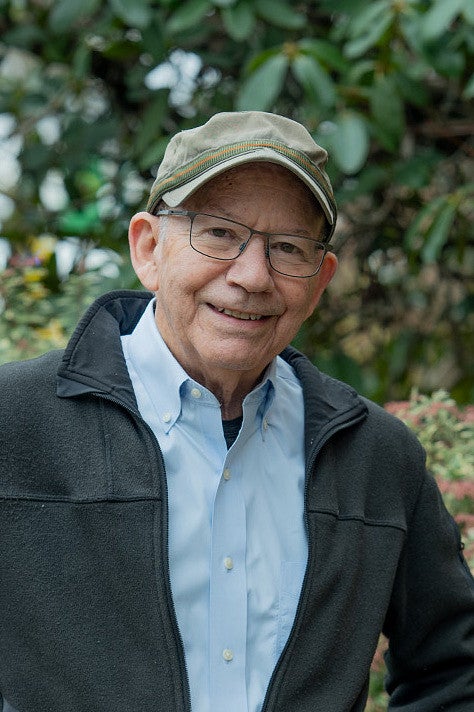
Education: Tufts University, with a bachelor’s; University of Oregon, with an interdisciplinary master’s in public administration, gerontology and counseling
Connection to UO: Senior fellow at UO’s Wayne Morse Center for Law and Politics; named an honorary Wayne Morse Chair in 2023; and frequently visit classes in different academic departments to speak about politics.
What’s in the fridge: All organic food, good beer and wine
Song on repeat: “Not Ready to Make Nice” by The Chicks
Coffee or tea: A dry Cappuccino
Favorite movie: Blade Runner
Advice to CHC students: Study and work hard, but always keep an open mind for opportunities on “The Road Less Taken.” (credit to Robert Frost)
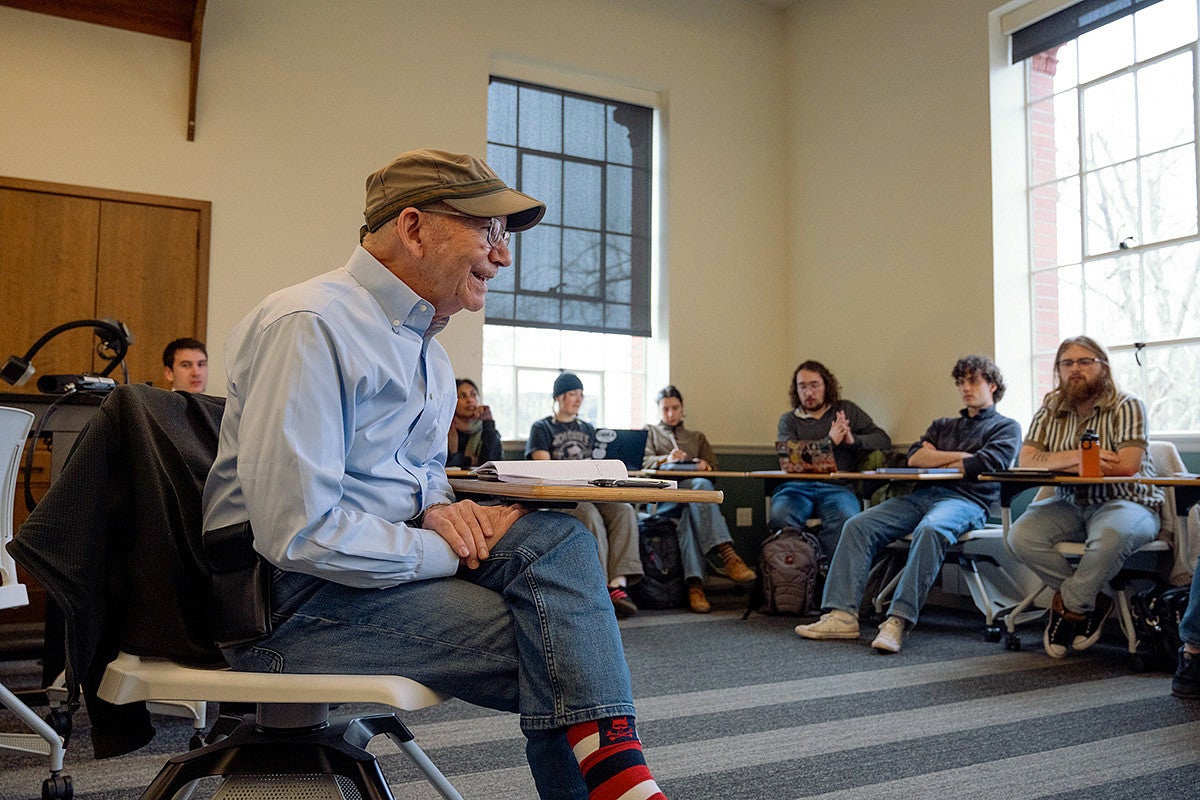
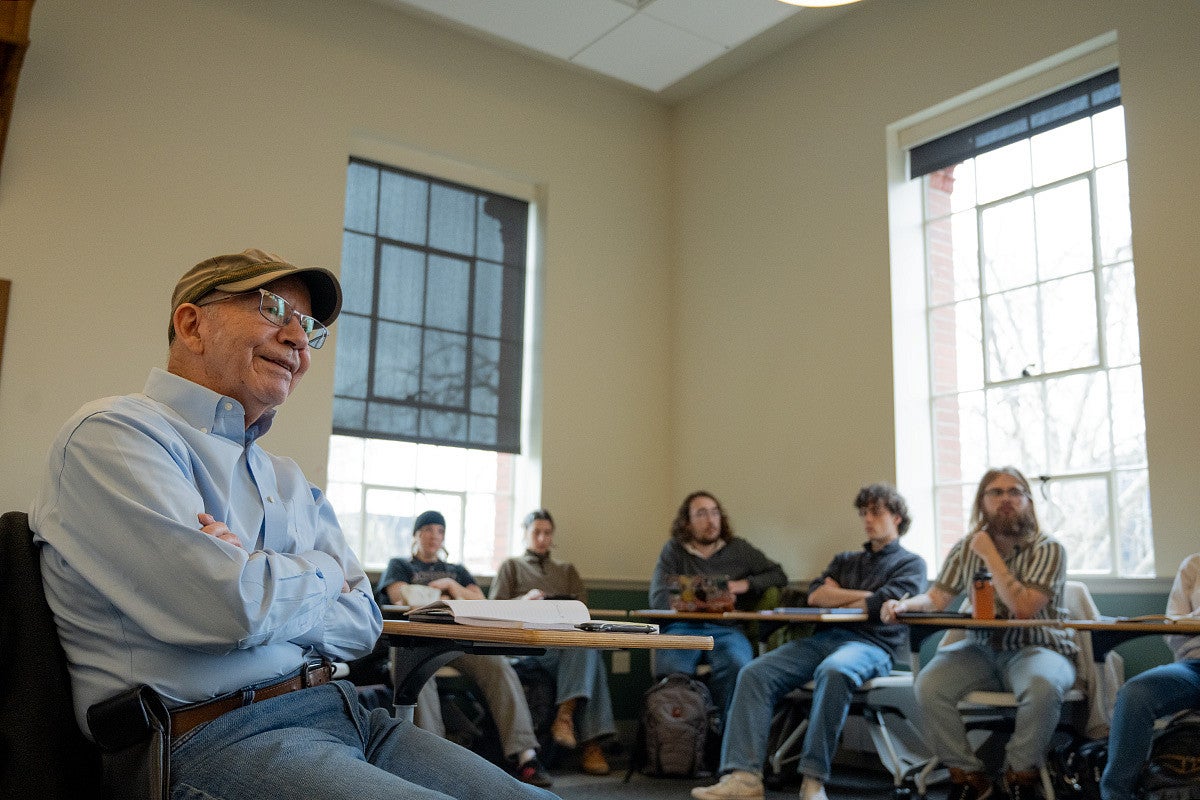
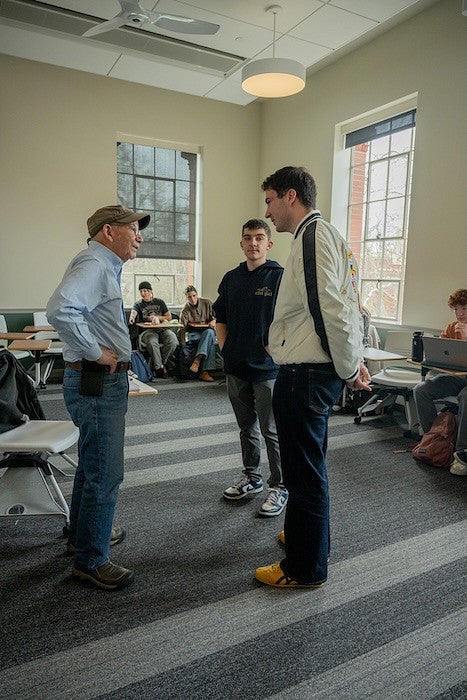
Twenty students are packed into Chapman 309 on a recent Friday afternoon. They huddle around Peter DeFazio, a legendary U.S. congressman from Oregon who is now retired and is teaching Clark Honors College students about democracy.
DeFazio sits at a desk at their level—no lectern, no slides. A composition notebook with a few handwritten notes is on the desk in front of him. For the most part, he speaks from experience.
“It’s put us in a massive downward spiral in this country,” he says while leading a discussion on the Citizens United Supreme Court decision, a topic he’s focusing on for his first official teaching stint at UO.
He cracks the occasional joke, but he’s mostly serious as the class engages in conversation about political influence in elections and voter registration laws. He always speaks anecdotally, referencing his 36 years in Congress—the longest tenure in Oregon history.
“When you’re learning about the political process, there’s always the feeling that you may be learning it secondhand, and you’re never sure what the truth even is,” says Harper Rich, a senior in the CHC who is taking the class. “But getting the perspective from somebody who has actual lived experiences—I believe him when he’s talking about congressional dysfunction.”
DeFazio’s journey from Congress back to a UO classroom didn't just happen overnight. His lengthy connection to the university and the state stretches back more than 50 years, to a chance encounter in a Massachusetts pharmacy.
It was May 1969, and DeFazio had just graduated from Tufts University. He was a member of the U.S. Air Force Reserve and was trying to figure out where he’d land next. Air Force officials encouraged him to become an intelligence officer, and they gave him four programs to choose from.
That was, until a copy of Holiday Magazine caught his eye at the pharmacy in Medford, Mass., not far from Tufts’ campus. An article about the Pacific Northwest detailed how Oregon had incredible beaches and snowy mountains – both within a short distance. “I can be right between both,” he recalled thinking.
He’d never been farther west than Colorado and decided to roll the dice. “I came to the University of Oregon, and thought I’d died and gone to heaven,” he says now.
His early involvement in political action as a graduate student led him to join the first Oregon Student Public Research Group when it was founded in 1970 and oriented him toward his lengthy career in politics.
He retired from Congress in 2023, but stays committed to public service. He works from his office at the Wayne Morse Center for Law and Politics, where he serves as a senior fellow. This winter, he’s teaching “The ‘American Experiment’ in Representative Democracy at 250: Can it Survive?” The course examines constitutional flaws, U.S. Supreme Court decisions, and Congress’s inability to get things done.
Teaching, however, is much different from legislating. DeFazio has been tasked with translating decades of institutional knowledge into a five-week course. As a final project, he’s encouraging students to identify solutions and next steps for democracy. “I'm hoping they come up with some ideas I didn't," he says, humbly.
The CHC Post recently spoke with DeFazio about what brought him back to UO, what he’s learned about teaching, and what he hopes a new generation can do to heal American politics.
This interview was edited for clarity and brevity.
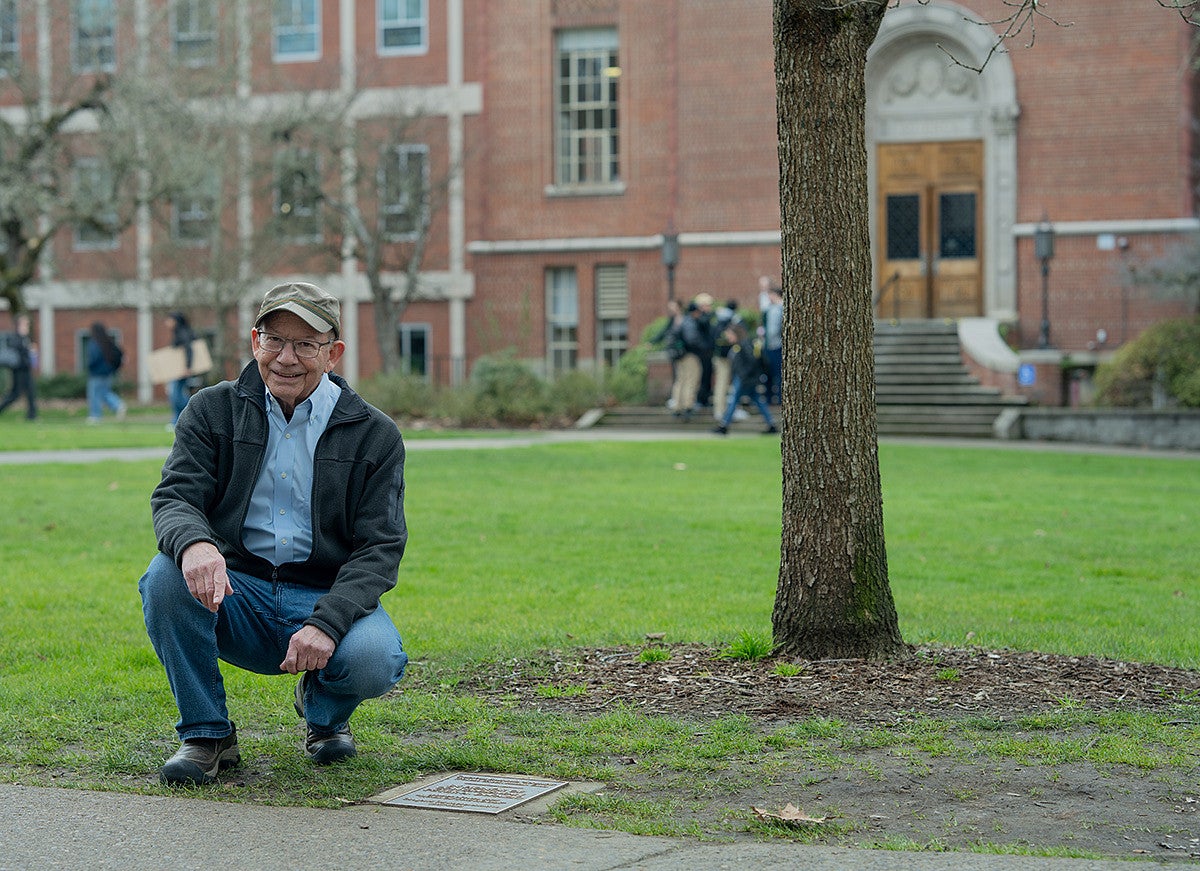
What brought you back to UO, and how did this class come together?
Well, 36 years in Congress—what am I going to do next? One natural thing was to do some consulting, but I was also offered the position of honorary chair of the Wayne Morse Center for Law and Politics. I gave the annual Morse lecture, which was a version of what I'm teaching now. I’d been giving variations of this speech since 2010, when I spoke at Oxford’s Merton College. I called it “America’s Representative Democracy: Can It Survive,” and the students and faculty were pretty shocked by the whole thing. That was just after Citizens United, the U.S. Supreme Court decision that removed limits on corporate spending in elections and opened the floodgates to unlimited funding in politics. So, I updated the speech for the Morse lecture to address current threats to our democracy, and I got friendly with Dan Tichenor, the director of the program on democratic governance at the center. Tichenor and his colleagues asked me to stay on as a senior fellow, and I began attending classes and meeting with students. Then I ran into Carol Stabile, the dean of the Honors College, at the disastrous (2025) Rose Bowl. The Ducks just can’t... anyway. She said, “Why don’t you teach a course at the Honors College?”
What did curriculum development look like for you?
Assembling the class readings took a lot of time because there’s no book that covers everything I want to include. I had to do a lot of reading and research to find the right materials. I started with the basics—the Constitution and essentially the flaws in it, the compromises that were made at the beginning that are haunting us today.
What are some of those constitutional flaws you started the course with?
When the founders were writing the Constitution, they had to get 13 states to sign on, and a lot of compromises had to be made. The most difficult ones dealt with the size and population of states—smaller states not wanting to be dominated by larger ones. But the most difficult was dealing with the Southern states and getting them to sign the Constitution, which dragged on for months. Then the other compromise was every state got two senators, and that is a huge and virtually insurmountable problem. By 2040, 30% of the people in America will elect 70% of the Senate because Wyoming, with less than a million people, gets two senators, and California with 40-some million people gets two senators. There’s also the Electoral College and gerrymandering. There are ways to deal with some of these things short of constitutional amendments, but I’m not going to lay out all the solutions. I want the students to figure that out.
How did your first term in the house compare to your last?
They seem like totally different institutions at this point. When I first came, it was a legislative body. For instance, in the late 1980s, there was a big debate over the vulnerability of our nuclear deterrence—whether we should have missile power or just enhance the submarine force. That was debated on the floor of the House for three or four days before it came to a vote. Amendments were allowed and there was real, substantive debate. These days, the massively and quickly growing Defense Department budget merits about two hours of debate and no amendments, or only amendments that are allowed by the Speaker of the House and the Rules Committee. It’s not really a legislative body anymore. Legislative bodies work from the bottom up. You take input, you have hearings, you make changes to a bill in subcommittee, you go to the full committee, you mark up the bill, anybody’s allowed to offer amendments. If you’re successful there, you go to the Rules Committee, which in the old days would generally just allow open amendments, and then you go to the floor of the House for a period of debate. Now, a lot of times subcommittees or even committees don’t mark up bills. If the committee does mark up a bill, it may get substantially altered by the Rules Committee at the whim of the Speaker of the House, and then it comes to the floor under very limited circumstances—very little debate, sometimes no amendments, sometimes a few amendments. It’s just a world of difference.
What changed?
That really began with the takeover by Newt Gingrich when the Republicans took the House for the first time in 40 years in 1994. In order to take over, he had to denigrate the institution and call it corrupt. That began that downward spiral. When I show students how this played out, I draw a Venn diagram—when I got to Congress, you had conservative Republicans, liberal Republicans, liberal Democrats, conservative Democrats. About 90 people in the middle pretty much decided where things were going to go. Then came Newt Gingrich and the overlap got smaller. Then the Tea Party election in 2010, and the lines don’t even meet anymore.
What do you want students to take away from this class?
I’m hoping they’ll feel empowered and not listless or hopeless about the future of the country. I hope some of them will get very involved through their careers, whether they do it politically, in law, or just through other forms of activism.
Are there any legislators today who you see carrying forward the kind of work you championed?
My successor, U.S. Congresswoman Val Hoyle, is a good friend. She’s only in her second term—I was there for 18—but she’s doing a great job in circumstances that are even crazier than when I was there. I was in the minority for half my career, but this is just insane now.
What do you do with your free time these days?
I love to hike in the wilderness areas, particularly the Eagle Cap Wilderness in northeastern Oregon—coming in from the south side where it’s less crowded. I won’t name my special spot. There’s a hike to a little lake on the shoulder of the Broken Top summit, which used to be solitary. But then it got written up in a magazine, or something, and now there’s a whole bunch of people. I think they even limit hikers now. You hike along a creek for a long part of the way. It was a canal for drainage or irrigation built in the late 1800s. Those wilderness areas were also things that I created as a legislator, so I can enjoy them now.
“I'm hoping they’ll feel empowered and not listless or hopeless about the future of the country," DeFazio says of his students. “I hope some of them will get very involved through their careers, whether they do it politically, in law, or just through other forms of activism, or being great journalists.”
Will we see more of Professor DeFazio in the future?
If I taught another course, I’d probably focus on the economic policies that have led to the class divide in America—free trade, tax policy, things like that. Or the corruption of the war powers granted to Congress in Article I and how presidents have usurped them. Depending on what kind of reviews I get, maybe I’ll get more requests.