
‘It’s never a straight path up’
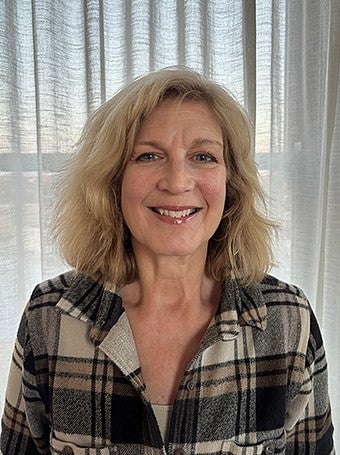
CHC Class of: 1983
Major: International studies
Hometown: Salem, OR
Now living in: Portland
Coffee or tea: Coffee, all day long
Song on repeat: I’m not a Swifty, but I love “The Fate of Ophelia” by Taylor Swift
Advice for CHC students: Enjoy the journey. Try to enjoy the educational aspect and the fact that you have all these brilliant professors at your beck and call. Don’t worry so much about the next step. Have confidence that when you’re there, you’ll meet those challenges.
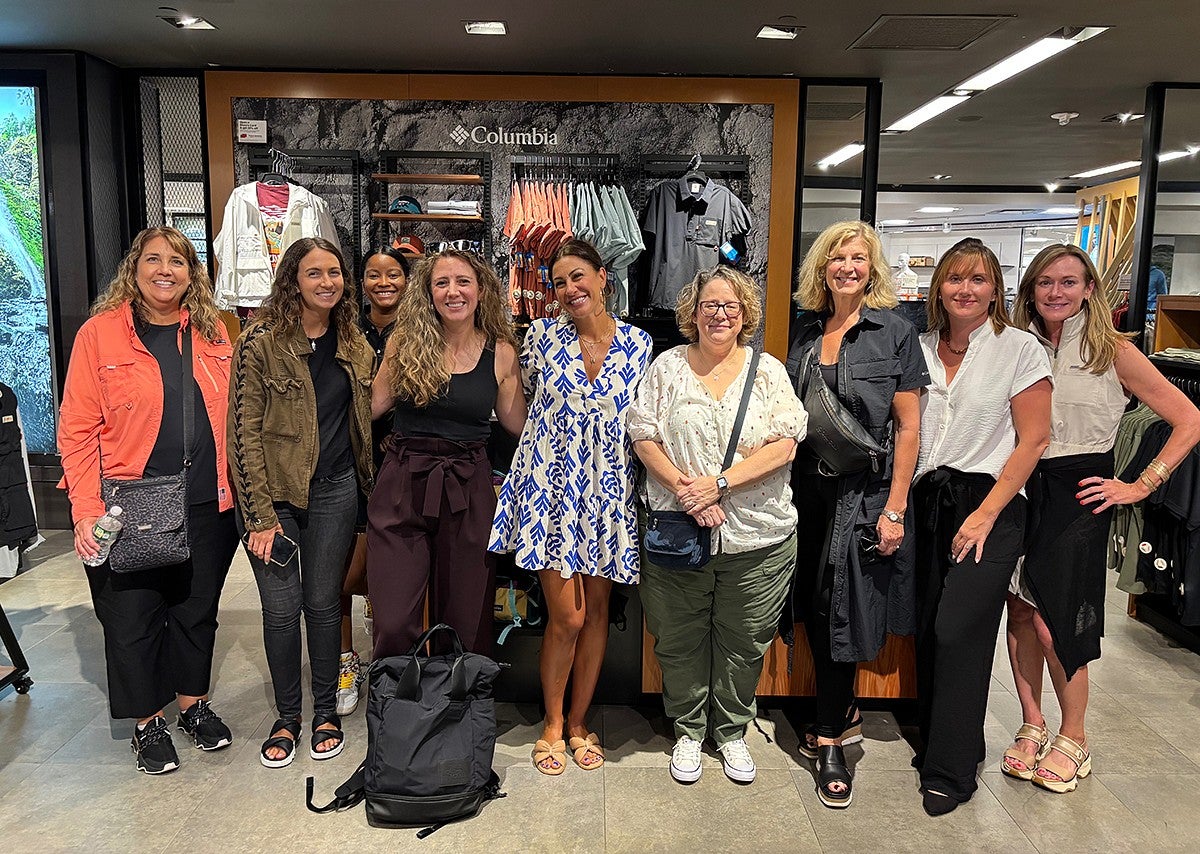
On a recent afternoon, Lisa Wenzlick sits in the company of her cats, Hank and Otis, while working from home. As the director of customer engagement at Columbia Sportswear, she spends her days in meetings, problem-solving for wholesale accounts around the world. The 64-year-old mother of three who once lived in Taiwan has been climbing the corporate ladder since the mid-1980s, but her path to international business success wasn’t as straightforward as she’d first imagined.
Growing up on a farm in Salem, Wenzlick dreamed of bigger places. “I remembered I wanted to be a flight attendant because all I wanted to do was travel the world,” she says now. It was always either education or travel for Wenzlick, and when she arrived at the University of Oregon, international studies became the perfect blend of both.
At the Clark Honors College, she was immediately struck by how professors practiced their craft. A psychology professor leveraged his research, using brain games to get students’ attention. It was very different from the way other professors just stood at the chalkboard, and it inspired her to practice what she studied.
In her senior year, Wenzlick focused her thesis on international women’s rights. Her rigorous work there laid the foundation for her lifelong advocacy for women. She later would raise three daughters, two of whom became Ducks, following in the footsteps of both Wenzlick and her husband, Michael, who also attended UO.
After graduation, she traveled to Taipei, Taiwan, to attend a year-long Stanford University language program. When she returned to Oregon with her degree and fluency in Mandarin Chinese under her belt, she was eager to dive into the career for which she had studied extensively. There was just one problem — she didn’t have any experience. The economy and the realities of breaking into international business meant Wenzlick had to find her own way in.
“The economy wasn’t great, and every company I approached said I’d need to work 10 years in the industry before getting into their international division,” she recalls.
It didn’t stop her from succeeding, and she later landed a job at Columbia. Now, she’s about to take on a role at the CHC – serving as a mentor to students, helping them prepare for their own career journeys after graduation. It’s part of the Honors College’s new Alumni Mentorship courses that will connect Wenzlick and other CHC alumni to students across various industries and markets. These specialized one- and two-credit classes feature networking events and panels stocked with professionals who are either alumni or friends of the CHC.
The CHC Post recently spoke with Wenzlick about her experience in the Honors College, how it helped prepare her for a career at a legacy Oregon brand and what’s on the horizon for her.
This interview was edited for clarity and brevity.
What did your time at the Honors College do for your career?
I would say two things: critical thinking to understand situations accurately and confidence that I could figure it out. I could figure out what I needed, what the next step was, or where I needed to go. The Honors College gave me the ability to break down a problem, understand it, research it, come to the correct analysis and then execute.
Another really important thing to keep in mind as you enter your career is to be flexible and take advantage of opportunities as they come. You never know what an opportunity will be like. I have taken opportunities that have played out differently than I imagined, but you can always learn from them. If something doesn’t bring you energy, don’t do it. But be open to new things. Be flexible, not just linear—sometimes we have to go sideways. It’s never a straight path up.
What was your career trajectory after leaving the Honors College?
After graduating in '83, I studied Mandarin Chinese at a Stanford program and came back in '84. We didn’t really have career counseling then. It was just kind of like, ‘You’re on your own.’
I started working at Meier & Frank (now Macy’s) in the lowest possible position — a temporary holiday role — because I needed money for Christmas. They immediately realized I was more than just a college student and asked if I wanted to do scheduling through the holidays. Every day, the store manager would walk by me, and he finally stopped and said, “We could go to Asia and develop product.” I’m like, ‘Yes, I would love to do that.’ He told me about the executive training program, and I had no other options, so I went into retail.
That’s how I became a buyer and planner. I worked at Macy’s for a while, became a stay-at-home mom, went back to Macy’s, and then went to Columbia.
What lessons have you learned from being at Columbia Sportswear for 15 years?
Treat people with respect. I think that’s a part of our culture that’s really, really good. Always do the right thing for yourself and for your team. Work the problem—there’s no problem that can’t be worked. Teamwork is really important. One of my favorite sayings is: ‘If you want to go fast, go alone. If you want to go far, go together.’ Prioritize a culture of trust and relationships, and make sure you have fun along the way.
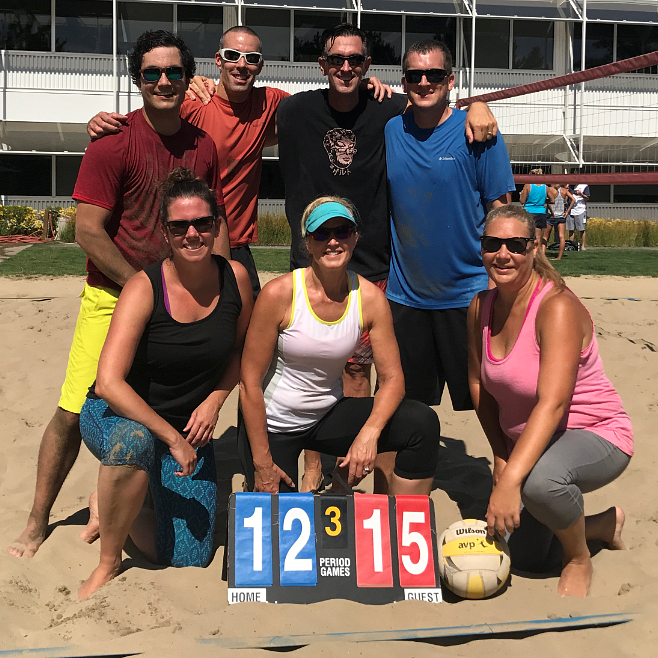
We have a sand volleyball net on campus at Columbia, so I play whenever I can. Every company has something fun that they do—or create the fun, create that community.
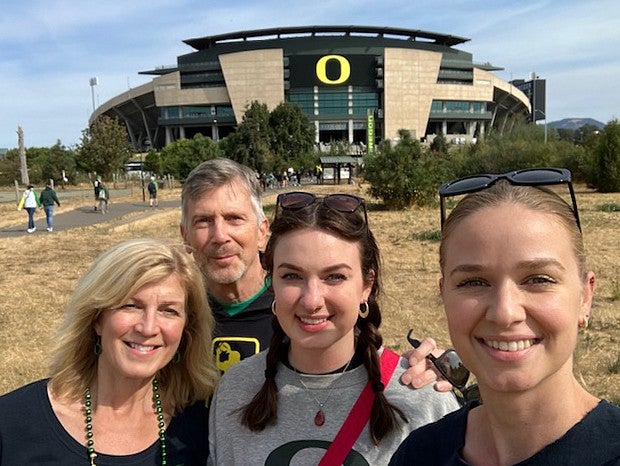
I would say humility, too. The president of Columbia, Tim Boyle, will stop and say hi. He knows I’m a Duck—he was also a Duck and sits on the UO Board of Trustees. So, a few weeks ago, I was with the president of Sorel and the head of sales for Sorel, and Tim Boyle walks by, and I thought, ‘Oh, he’s going to talk to these two.’ And he looks at me and goes, “Go Ducks!” because it was before a football game. It was just like, how nice was that?
What did the Honors College teach you that you still live by?
Time management. Writing a thesis, I will say, was one of the hardest things I’ve ever done. My joke is, I’ve given birth three times, and I’ll say the thesis is in the top five. Learning how to write a paper like that and doing something so out of your comfort zone is such an accomplishment.
That’s where I learned to have confidence that you can do it. You have to break it down, make it manageable, time manage it. And make sure you have good advisors. Make sure you have a well-vetted cadre of people supporting you. I didn’t have somebody then from the Honors College helping me, but they do a better job now of checking in and having better timelines.
The other thing was just the connectivity with the professors. Having more one-on-one time with professors was amazing.
What was your thesis about?
It was about the status of women in China. My area was Chinese history, and I studied specifically foot binding. It’s a horrible process. Did the status of women improve with communism? Yes, it did. But the way women were oppressed in Chinese culture is really breathtaking. They were literally crippled so they couldn’t walk as a beauty standard.
It was cloaked as a beauty standard, but really what it was is a way to repress women. Women perpetuated this against other women because if you had bound feet, you could marry into a higher level of society. If you were flat-footed, you basically could not find a husband—you would be a slave the rest of your life. It’s just amazing what we do to oppress other people.

If you could do anything over having to do with your education, what would it be?
I would have way more fun. I’d be less worried about studying. It goes back to the first thing —enjoy the journey. I’d certainly go to more football games. I’d have more fun, do more free activities. At the time, I just studied, studied, studied. But our brains also need that downtime.
Steve Jobs, the late co-founder, chairman and CEO of Apple, did something totally different than coding in his younger years. He audited a calligraphy course while he attended Reed College — and that’s how he realized design was really important. That’s why Apple products are so beautiful. Having that openness to learning in different ways and giving your brain time to relax and do something different — that’s really when you can have epiphanies.
“Having that openness to learning in different ways and giving your brain time to relax and do something different — that’s really when you can have epiphanies.”
What’s it like having so many Ducks in the family?
It’s really fun! My daughters have two degrees from UO between them. One got her undergraduate degree in biology and my youngest daughter just graduated from the law school.
The funny thing is, my husband and I are both Ducks, but we did not meet at UO. Had we met on campus, we probably wouldn’t have gotten together because we were in completely different social circles. He was drinking beer at Duffy’s and I was having champagne at Excelsior on Fridays. I studied a lot, and he didn’t. He was not in the Honors College — he was an accountant, which is a tough degree to earn in its own right. But yeah, we would have mutually said, ‘You’re part of that group,’ and probably never hung out together.
How are you connected to the Honors College today?
I’ve been donating to the Honors College for a while now, and now I’m going to help out with the new mentoring program. At this point in my career, I’m happy to give back. I’ve had a lot of people give me a hand up and teach me valuable lessons. Whatever I can do to help the next generation, it would bring me great joy — particularly for women and the unique challenges that women face. I’m looking forward to being an advocate, a sponsor, a mentor for the next generation.