
When STEM and art converge
Role model: My mom
What’s in the fridge: Sparkling water and my dog Lucy’s food
Binge watching: Any limited series
Favorite song: I’ve been really obsessed with “Smalltown Boy” by Bronski Beat. I heard it on one of those limited series.
Hobbies: Playing violin in a community orchestra, bike riding, rewatching TV shows, shopping for secondhand clothes
What CHC students should know about you: I always have a podcast recommendation for you.
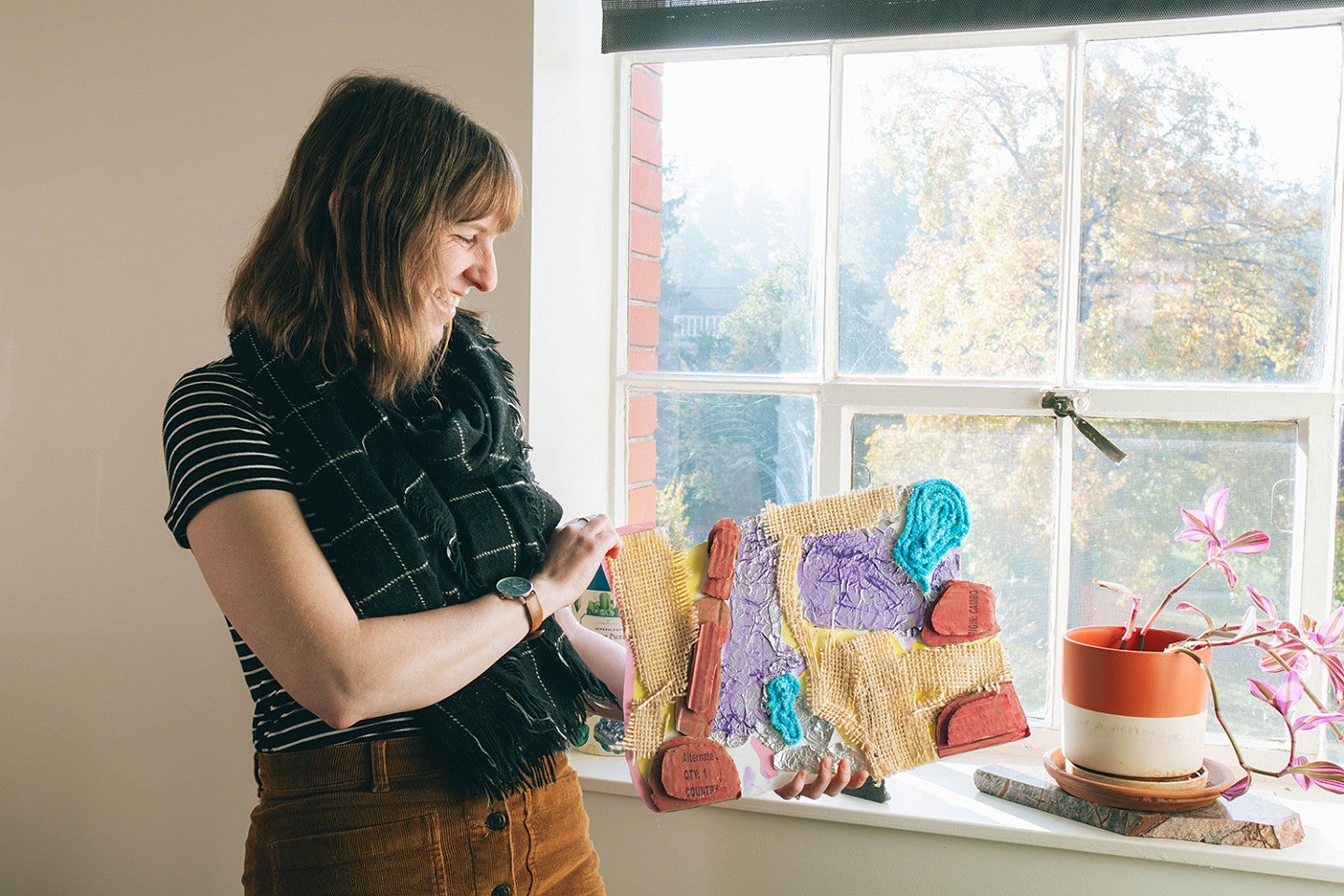
Any time CHC assistant teaching professor Kristen Rahilly enters her office on the third floor of Chapman Hall, she’s greeted by an assortment of artwork created by students from her science classes.
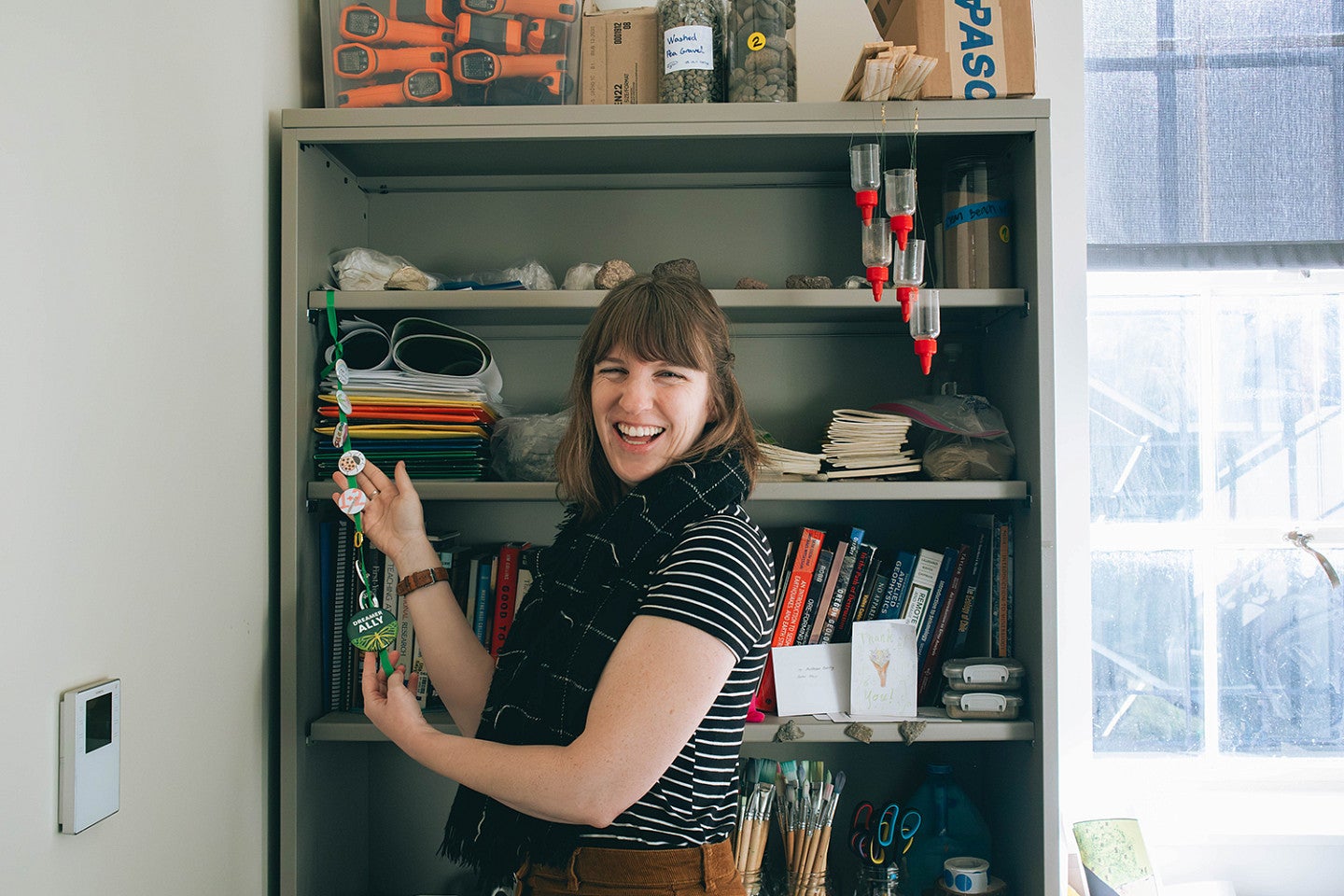
There are small paintings based on images taken from outer space. There are buttons attached to a ribbon that were made as part of a class for Eugene preschoolers. And there are other pieces of work scattered across her bookshelves by students.
How does Rahilly, who teaches earth science, geology, and other science-related topics, encourage her students to make art? By combining science, technology, engineering and math – known as STEM – with students’ naturally creative side.
“I’m a scientist, and by no means do I consider myself an artist,” she says. “But I know that every student I work with has a creative side. Connecting STEM and art ensures that the human piece is part of the work.”
Rahilly, in her third year at the CHC, is in the midst of teaching “STEM + Art” for fall term to first-year Honors College students. She has also found ways to implement art projects into her “Changing Landscapes” course, which focuses on using satellite images of the Earth to chart climate change.
As a child, Rahilly grew up in Nashua, New Hampshire, the oldest of three kids. She excelled at school, especially in science. A self-described shy kid, Rahilly found comfort in her classes and liked her teachers.
Her parents also wanted their children to be involved in the arts, including music. Her sister played the piano and her brother chose guitar. Rahilly picked the violin, an instrument that she still plays today.
At 15, she saw a financial commercial that focused on a volcanologist who explained that he didn’t have time to go to the bank because he was always outside, chasing a series of adventures. She was hooked. “What could be more exciting?” she recalls thinking at the time.
Rahilly attended Smith College and later went to University of Alaska-Fairbanks, where she earned her Master’s of Science. But it was a stint teaching eighth grade in Mississippi that led her to a different conclusion about science.
“I sensed that my love for science was more about showing the beauty of it through teaching others about it,” she says now, noting that she also taught elementary students for several years. “I loved the challenge of being in a K-12 classroom and having to think on my feet and being creative.”
Today, her STEM + Art class allows CHC students to understand the intricacies of teaching science to children in a classroom setting. “I have great respect for K-12 teachers,” Rahilly says. “I want to show our students how hard that work is.”
The CHC Post sat down with Rahilly to discuss her scientific and teaching journey. This interview was edited for brevity and clarity.
What made you decide to draw up a course on STEM and art? In most classes, these aren’t two things that you see together here? Tell us about your thinking in creating the class.
I really wanted to create something that would focus on how to teach K-12 students STEM using hands-on, or “inquiry-based,” learning. This is because I truly believe that K-12 teachers have one of the hardest jobs in the country and I wanted my students to gain some perspective on the challenges that exist in real classrooms across the United States. I was an eighth-grade science teacher in a public middle school in Mississippi and worked for two years in elementary classrooms in Fairbanks, Alaska. Now as a scientist, I feel a personal responsibility and passion towards sharing my love of science with K-12 classrooms. So, I was set on teaching this STEM class at the 101 level in the CHC. STEAM is something that I was introduced to through my journey in the STEM education world. The idea behind STEAM is to integrate art within the STEM subjects – so I tell my students the first day of class that we won’t be using STEM + Art anymore. Instead, our class is all about STEAM! I knew that transforming my course into one focused on STEAM vs. just STEM teaching would be the exact type of boundary-pushing class that we pride ourselves on having in the CHC.
I just went to a STEAM conference at Oregon State University and heard one of the presenters summarize the idea behind STEAM so beautifully. Art is the human piece that we need in STEM! STEM should never be separated from our humanity, and STEAM is the way to really ensure that. I didn’t know about the STEAM acronym when I was in my 8th grade classroom over 10 years ago. But I quickly learned that I could connect with some of my hardest-to-reach students any time I brought design, creativity, resourcefulness, fun, and problem-based learning into what we were doing that day.
You teach science. How does art fit into your world? What is your background with art?
I would say I’m a big fan of art and the incredible work artists do, but I wouldn’t identify myself at all as an artist. However, growing up, it was really important to my parents that my siblings and I all learned a musical instrument. I grew up all through high school playing violin and I thought for a while that I wanted to pursue being a conductor. My original dream was to conduct the Boston Pops orchestra! I realized, however, that my heart was not in practicing the hours a day required of professional musicians. As I was learning violin, I started out seeing it as a very analytical thing but slowly began to understand what musicality and artistry was. I’m in an amateur orchestra here in Eugene called the Eugene Springfield Community Orchestra and whenever I am in our Tuesday night practices I just find myself smiling the entire time.
My other pursuits of art are extremely oriented with my love of science. I teach a course called “Changing Landscapes” at the CHC and that’s where students learn how to find and analyze satellite images that they then paint to help them focus in on small and large details. I think satellite images are absolutely stunning. In my free time, I do the nerdiest thing ever and find images that I think are pieces of art themselves. I also just went to a workshop where we learned how to translate data into music. I composed a mini musical piece for violin based on the biomass of Arctic vegetation – so fun!
What’s the goal for this class for students?
For my students to learn how challenging it is to be a K-12 teacher in a public school in the United States. Each week, I model a STEAM activity for my students at a specific grade level. Recently, we did an activity geared towards eighth graders and used pieces of popular music to align the swing of a pendulum with the beats of the music. We also modeled an activity for third graders that involved creating sculptures of seed pods. Throughout the class, students create their own hands-on STEAM activities for either third graders, eighth graders, or high schoolers in a way that is inspired by what I model in class. It is incredibly challenging because I ask the students to fully integrate art in a meaningful way. So, they must think of an activity where removing the art component would make the activity fall apart or the science learning less effective.
We end the term by doing a “STEAM Night” with the four-year-old class at the Vivian Olum Child Development Center. My students create STEAM activities in small groups and then they actually teach their activities to the class – it is absolute chaos in the best possible way!
How does teaching a class like this at the CHC move students forward?
I believe K-12 teachers are some of the most talented and skilled individuals out there. Teaching gives you skills in so many areas that are applicable across fields: project management, public speaking, resourcefulness, resilience, and – my favorite – chaos coordinator. So many CHC students who come in wanting to pursue STEM majors are also talented artists. I am working with a second year-student who took my class last year named Hain Kim. Hain received a First Year Research Experience grant from UO to work with me over the summer to create a visual storytelling game using her own fantastic illustrations. The game is called “A Week in the Worm Lab” and she is creating it for AP Biology classes at the high school level. Her main goal is to allow high schoolers to see themselves as scientists in a science lab through her art and storytelling! She is planning to present this project at an upcoming meeting of the National Science Teachers Association in Portland next fall.
Is there a childhood memory that comes to mind when you think about what it was that spurred your love of teaching?
When I was little, I loved to play “teacher” with all the kids in my neighborhood. But I really didn't decide to pursue K-12 teaching until I was a teacher's aide in graduate school. I did this program funded by the National Science Foundation that puts science graduate students in public school classrooms. I got placed in a first-grade teacher's room in Fairbanks, Alaska. This teacher was brilliant. We spent the whole year writing science-themed songs that we taught the first graders to sing around every science unit and ended the school year with a "Science Celebration.” I know I experienced a lot of joy in the classroom as a student growing up, but that was the first time I saw the behind-the-scenes effort that K-12 teachers make to bring joy to their students. It was after doing that program and having such excellent teacher models that convinced me to pursue a K-12 teaching degree and position.
Best piece of art you ever saw and why?
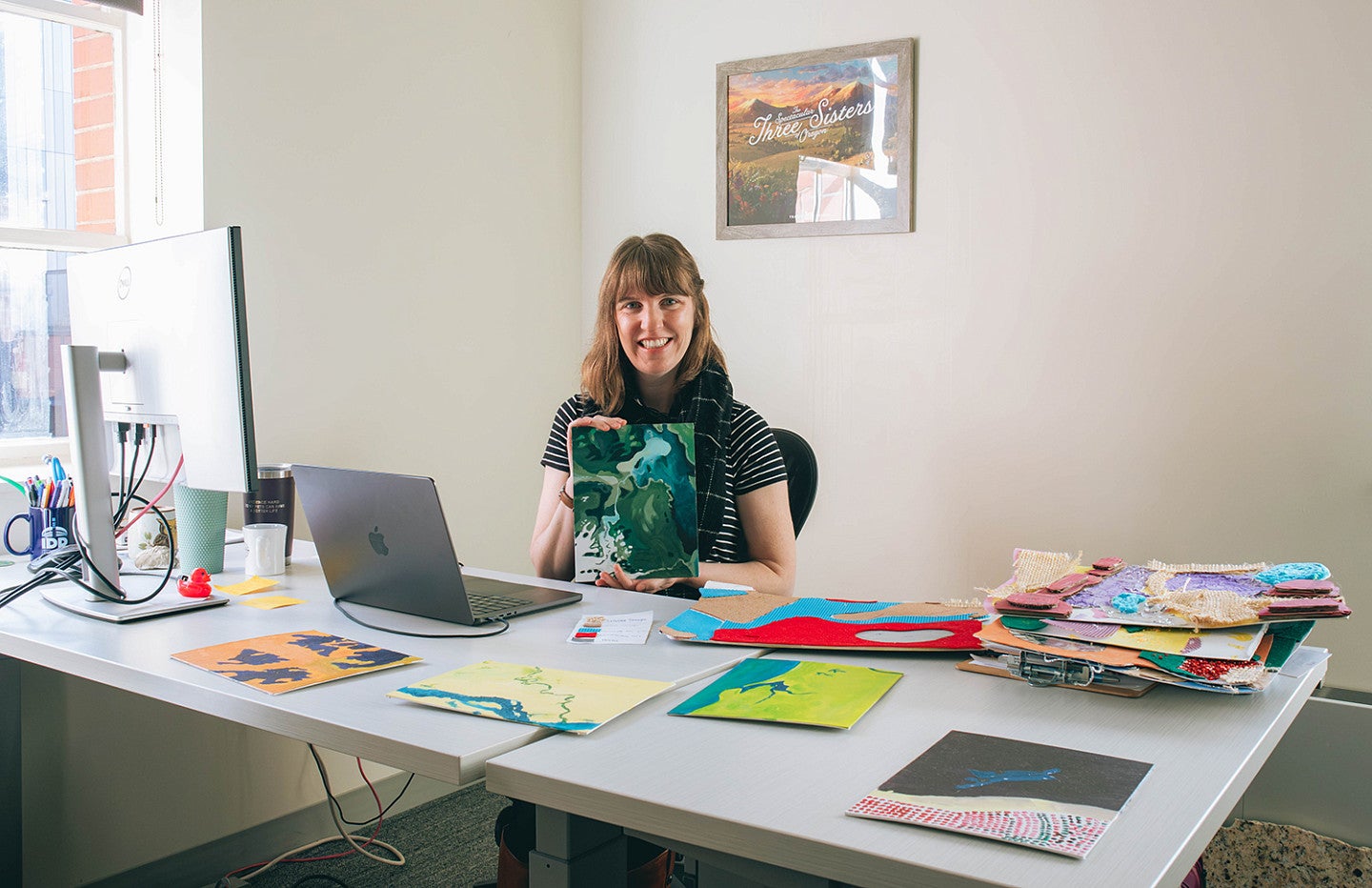
I have some amazing paintings in my office. One is from a CHC art major who came up to me the first day of class and told me she wasn’t “a STEM person.” Her painting is of a satellite image that shows flooding due to glacial melting in Juneau, Alaska. It is absolutely gorgeous – I look at it every day.
If a student considering the Honors College sat in on your class, what should they expect?
You can expect to be tested to think outside the box of what it means to be a scientist, an artist, and an educator.