
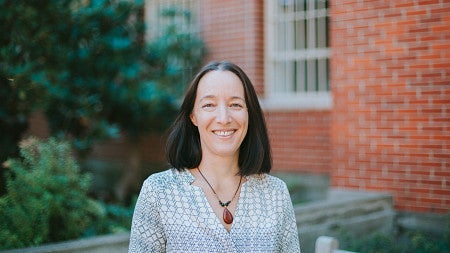
CHC Faculty-in-Residence Lisa Munger
Story by Claire Warner, CHC Communications
Photo by Maddie Knight, CHC Communications
Donning 100 pounds of SCUBA gear, Lisa Munger dove into the icy waters of Antarctica 40 times to study her favorite marine mammals, Weddell seals. After two years of collecting data through the McMurdo Oceanographic Observatory (MOO), she and other researchers determined that the chirping pinnipeds were also producing ultrasonic sounds, inaudible to human ears. But one question still remains: why?
“They’re almost certainly communicating, but there could also be other functions or side-benefits of these sounds,” Munger said, “One of which might be to help them navigate through their environment. Sometimes there can be literally no light under the ice, especially during polar winter, so sound might be a pretty useful tool for them.”
She and UO Biologist Paul Cziko reported their findings in a scientific paper published last December in The Journal of Acoustical Society of America. Munger hopes to continue studying Weddell seals so she can investigate why they make these sounds and determine which seals — males, females, or juveniles — vocalize at the highest frequencies.
Weddell seals fascinate Munger in other ways, too, as they are the southernmost marine mammal and are well-adapted to their environment. They can hold their breath for over 80 minutes, have excellent vision, and sensitive whiskers that help them navigate in the dark, she added.
The seals’ capacity to thrive in extreme conditions is reminiscent of Munger’s ability to adapt in the classroom and create an engaging learning environment, despite the difficulties of the pandemic.
“If something isn’t working or I think we can do something better, I will try to improve my classes sometimes on the fly,” Munger said. “I think that also keeps students engaged and on their feet because they don’t necessarily know what’s going to come next.”
In the spring of 2020, Munger taught “Mystique of Marine Mammals,” a CHC colloquium that focused on the science, folklore, and culture surrounding marine mammals throughout history. While it may have been natural for students to feel detached in a distanced learning environment, Munger’s determination and resourcefulness kept students’ energies high as they observed numerous indigenous artifacts — many of which were crafted from the bodies of marine mammals — from UO’s Museum of Natural and Cultural History through a virtual field trip.
Munger also adapts to students’ various learning styles by utilizing several learning modalities in her classroom such as videos, visuals, collaborative projects, and experiential learning. In Munger’s class later this academic year, “Backyard Soundscapes,” students will learn about acoustic monitoring and how to identify and analyze sounds through a scientific research project. In another course, “Nature of Sound,” Munger teaches her students about sound production and reception, sound ecology, soundscapes, and conservation issues related to noise pollution.
“The importance of sound in natural systems and our systems is often overlooked,” Munger said, “But sound is really another dimension of existence that we need to think about when we think about conservation and management and human impacts on natural environments.”
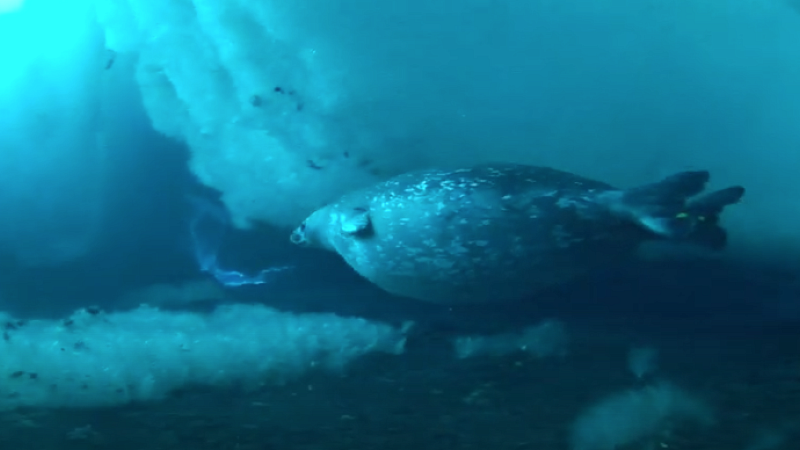
One of the Weddell seals Munger studied while in the Antarctic.
Munger believes acoustic monitoring is essential when determining relationships between soundscapes and population trends. For example, the four-centimeter pistol shrimp makes a lot of noise for its small size and has an enormous impact on the surrounding ecosystem. Also known as snapping shrimp, pistol shrimp have an enlarged claw and when they close it, a bubble forms, bursts, and releases a sound that stuns their prey.
“In coral reefs, because of all of the nooks and crannies and crevices, a healthy reef will be populated with thousands or millions of snapping shrimp,” Munger said. “And so the snapping shrimp sound, when you put them all together, sounds like Rice Krispies. Just ‘snap, crackle, pop,’ constantly.”
Munger said that healthy reefs tend to have larger populations of pistol shrimp and are therefore louder. Reefs that lack the “snap, crackle, pop” are likely to be covered in algae, buried in sediment, or lack biodiversity. A discovery that has surprised many scientists, including Munger, is that many larval crustaceans, fish, and corals find their way to coral reef habitats via the snaps of pistol shrimp.
“We don’t know exactly how they hear,” Munger said. “They don’t have ears like we do, but something about that sound provides a cue to these larval organisms that it’s a good place to settle and then grow into their adult form.”
Munger intends to continue sharing her passion for marine bioacoustics with CHC students through not only her courses but by giving students mentored research opportunities to analyze existing data from projects such as the MOO. She is excited to see what findings continue to lurk beneath the Antarctic sea ice.
“We’ve got two years’ worth of images and video from this amazing Antarctic marine ecosystem, along with the audio data and ocean conditions,” Munger said. “We could do a lot with that, so I think there’s definitely more to be learned.”
Related story: UO team finds Weddell seals make unheard-of sounds